
What
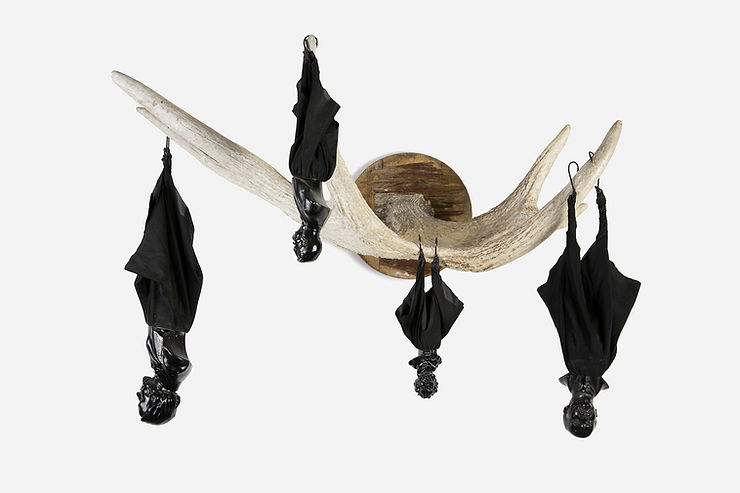
Moose horn, fabric, fishing hooks, mixed media
Who
Max Epstein, b. 1974
Why
“This work is an ironic metaphor describing Russian culture and education based on four small sculptures of Russian and Soviet figures: Pushkin, Gorky, Glinka and Lenin. These four figures influenced education and culture in the Soviet Union, and are related to my childhood and family. As a poet, Pushkin enhanced the freedom of expression in Russian. Gorky, a Soviet writer, was present each time I looked at the sign bearing the name of my childhood street. Glinka is a 19th-century Russian composer, and the music school I attended was named after him. And Lenin was present just about everywhere – at school, in cultural centers and at movie theaters.
The portraits of these four figures stood on the bookshelves in my grandfather’s home. I always wanted to play with them, but it was forbidden for me to touch them. Following my grandfather’s death, in Jerusalem, my family wanted to throw them out, but I took them home, fulfilling my childhood desire to play with them and transforming them into the bats that once pursued me.”
This work is part of a long-term project centered on Russian-speaking Jerusalemite mythologies – for which I collected abandoned belongings, transforming them into metaphorical objects.”
Where
On display at the Migdal Gallery, Tel Aviv Biennale of Crafts & Design, MUZA – Eretz Israel Museum, Tel Aviv.
More Articles

New Acquisitions: Gifts from the Tennenbaum Collection to the Glass Pavillion Over 70 glass items from the Rivka and Zvi Tennenbaum Collection have been donated to the Glass Pavilion in memory of their son, the flute player Yadin Tennenbaum, who was killed at the Suez Canal in the Yom Kippur War
18.04.24

New Acquisitions: Works Exhibited at the Biennale of Crafts & Design Some 60 artists whose works were exhibited at the Biennale of Crafts & Design held at the museum in 2020 and 2023 generously contributed their works to the collection of MUZA, Eretz Israel Museum, Tel Aviv
18.04.24
International Conference: DAY 1 – movies and lectures
24.01.22