
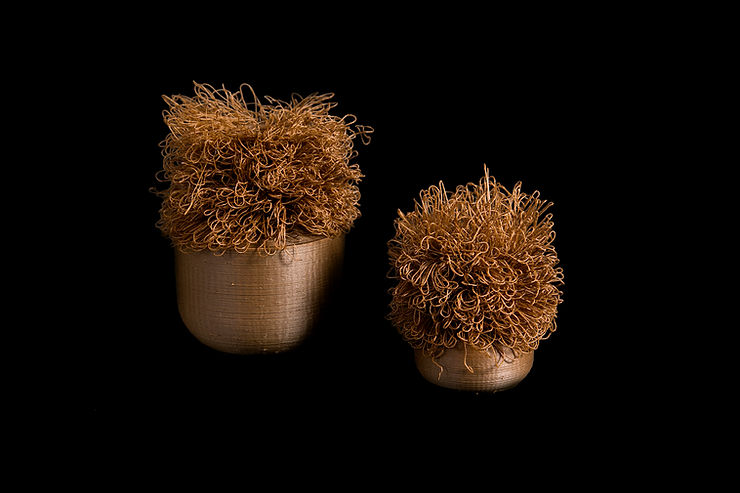
What
PLA filment, bamboo fill, wood fill; 3-D printing
Who
Why
A series of vessels exploring how a 3-D printer responds to changing forms and volumes, and gives rise to new forms.
“This work grew out of my interest in the limits of advanced, highly precise technologies, and in characterizing the new formal patterns created when the rules change. In this project, I explored how a 3-D printer responds to changes in forms and volumes, lines and surfaces, which were planned using different CAD programs. The characterization of the qualities responding to my definition of ‘success’ or ‘failure’ was significant to the analysis of the final, printed products, based on the identification of different parameters in the planning stage. The printing parameters chosen for the final models were further adapted to create vessels that combine new and familiar volumes.
To this end, I designed a series of vessels with a voluminous ‘mother base’ that gives rise to a complementary voluminous-linear form or an additional structure with a unique texture, which adds an individual character to every printed object. This quality distinguishes the vessels from the conventional products of a 3-D printer, which strives to produce the most perfect and precise form.”
Where
On display at the Glass Pavilion, Tel Aviv Biennale of Crafts & Design, MUZA – Eretz Israel Museum, Tel Aviv.
More Articles
An Interview with Raed Bawayah Taken from the "Black Life. White Art" exhibition catalogue published recently. Interviewer: Guy Raz
30.04.24

New Acquisitions: Gifts from the Tennenbaum Collection to the Glass Pavillion Over 70 glass items from the Rivka and Zvi Tennenbaum Collection have been donated to the Glass Pavilion
18.04.24
New Acquisitions: Works Exhibited at the Biennale of Crafts & Design Some 60 artists whose works were exhibited at the Biennale of Crafts & Design held at the museum in 2020 and 2023 generously contributed their works to the collection of MUZA, Eretz Israel Museum, Tel Aviv
18.04.24