
Photo: Hadar Saifan
What
Plaster, Formica laminate; mold casting
Who
Yonatan Ullman, b. 1982
Why
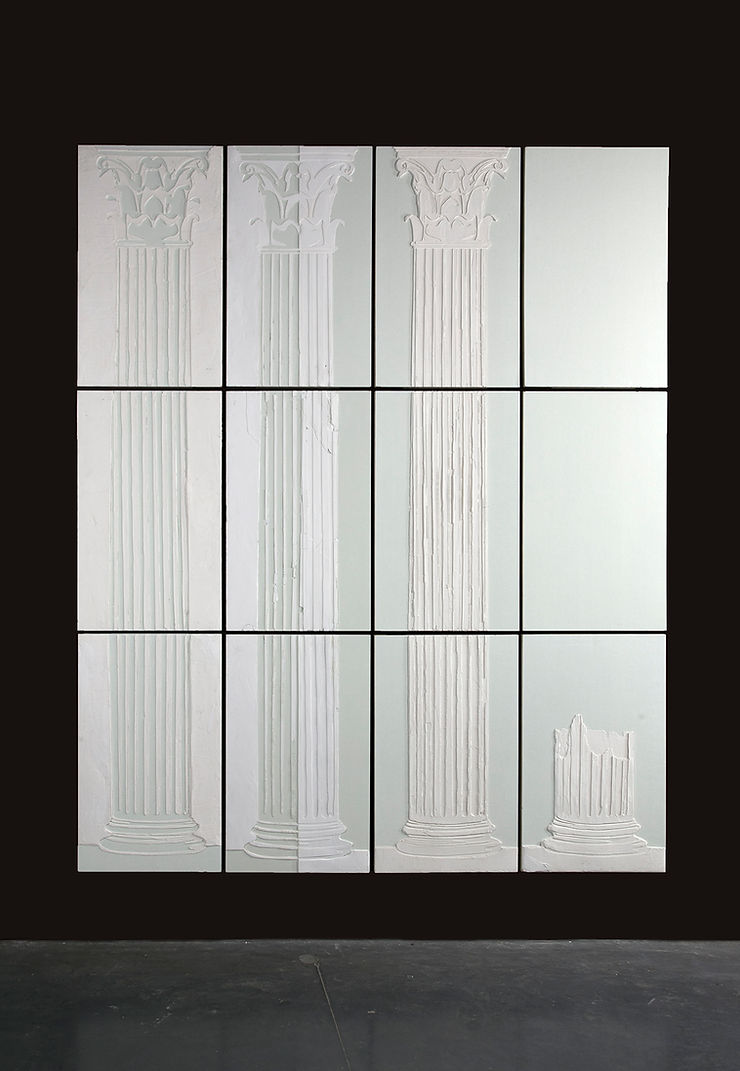
“This series of plaster reliefs presents the ‘life cycle’ of a Corinthian column, one of the three main orders (styles) of ancient Greek and Roman architecture, in four stages: The column is “imprisoned within the block”; one half of the column is “imprisoned within the block” while the other half has been “extricated from the block”; like the birth of Venus, the column is “extricated from the block” and is seen in all its glory; all that remains of the glorious column is a stump.”
In order to create this work, I developed a unique technique that involves casting layers of plaster into thin molds placed on Formica surfaces. The result is a work that ‘hovers’ in the undefined space between two and three dimensions, between an unrealized proposal for a sculpture and the vague memory of a sculpture that once was yet no longer is. The materiality also creates an elusive visual effect – the white Formica has a greenish tint, while the white plaster appears to have a pinkish one.
This work presents a sequence of four scenes that can be viewed as a story unfolding in space and concerned with its own process of creation – a self-reflexive metaphor of the creative process from a perspective that views all temporal possibilities as occurring simultaneously. The stage of the idea’s germination is a womb-like process of incubation, which is presented as the ‘negative’ of the finished column; the prolonged execution process is represented as a birth, or a transition from ‘negative’ to ‘positive’; the moment in which the work presents itself in full is represented as a glorious Corinthian column. What follows is the recognition (which is usually avoided) that the end of every creation is death – a stage represented by the felled column.
“My grandmother, Lisa Ullman, spent over a decade – from age 77 to age 87 – retranslating Josephus Flavius’ ‘The Jewish War’ from Greek into Hebrew. When asked in an interview how she achieved this, she answered simply: “One page at a time.’”
Where
On display at the Rothschild Gallery, Tel Aviv Biennale of Crafts & Design, MUZA – Eretz Israel Museum, Tel Aviv.
More Articles

An Interview with Raed Bawayah Taken from the "Black Life. White Art" exhibition catalogue published recently. Interviewer: Guy Raz
30.04.24

New Acquisitions: Gifts from the Tennenbaum Collection to the Glass Pavillion Over 70 glass items from the Rivka and Zvi Tennenbaum Collection have been donated to the Glass Pavilion
18.04.24
New Acquisitions: Works Exhibited at the Biennale of Crafts & Design Some 60 artists whose works were exhibited at the Biennale of Crafts & Design held at the museum in 2020 and 2023 generously contributed their works to the collection of MUZA, Eretz Israel Museum, Tel Aviv
18.04.24