
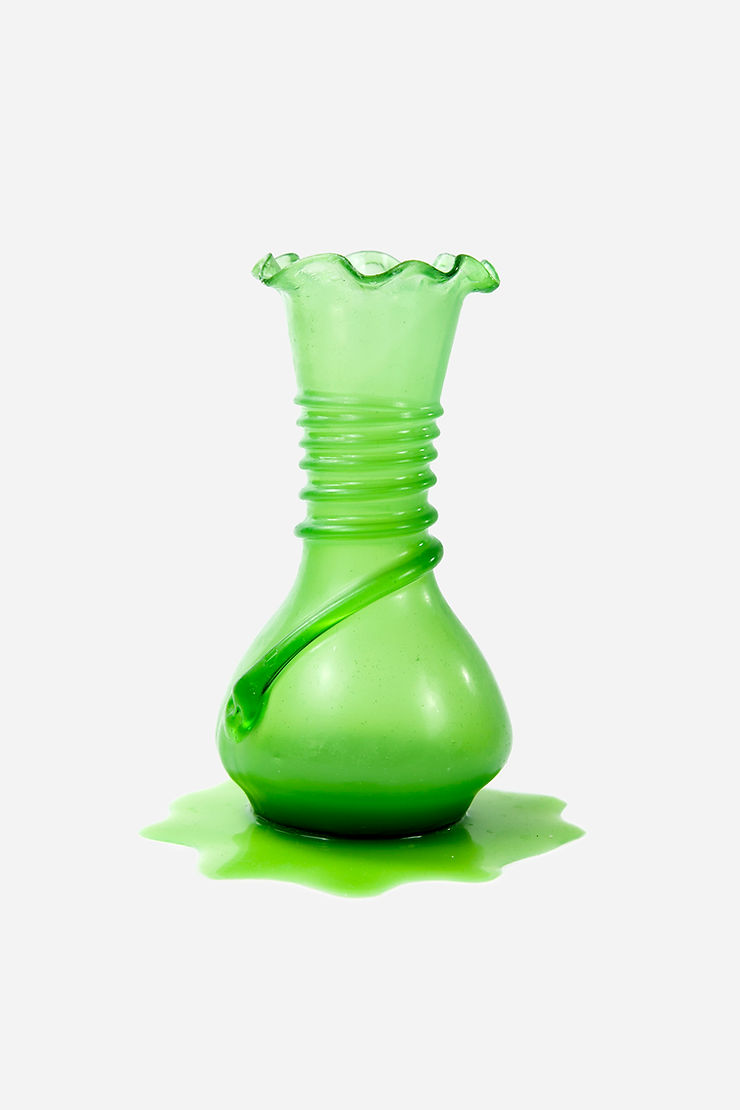
What
Traditional Hebron glass vessels, silicone; hand blown
Who
Shirly Bar-Amotz, b. 1974; Yaniv Kneller, b. 1972
Why
Shirly Bar-Amotz and Yaniv Kneller’s work was created following a special tour of the museum, which they undertook in the company of curator Henrietta Eliezer Brunner. As they recall, “We walked down a narrow staircase to the collection of the Glass Pavilion. There, on a shelf behind a door, ordered like outmoded souvenirs, was a collection of hand-blown Hebron glassware. Once found in almost every Israeli household, it has since practically disappeared.” Bar-Amotz and Kneller’s work attends to these forgotten objects. They present us with a limited repertoire of original glass vessels created in the city of Hebron, which they have covered with a thin layer of silicon, whose marks are only apparent in the melted material on the bottom of the objects. Their work calls attention to a 600-year-old local craft industry, which has been disappearing in recent decades. According to them, the addition of the insulating layer, which does not allow for direct contact with the glass, symbolizes the policy of separation and division that is implemented in Hebron, and which has been disrupting the life of its residents since the massacre in the Cave of the Patriarchs 26 years ago.
Where
On display in the Glass Pavilion, Tel Aviv Biennale of Crafts & Design, MUZA – Eretz Israel Museum, Tel Aviv.
More Articles
New Acquisitions: Gifts from the Tennenbaum Collection to the Glass Pavillion Over 70 glass items from the Rivka and Zvi Tennenbaum Collection have been donated to the Glass Pavilion in memory of their son, the flute player Yadin Tennenbaum, who was killed at the Suez Canal in the Yom Kippur War
18.04.24
New Acquisitions: Works Exhibited at the Biennale of Crafts & Design Some 60 artists whose works were exhibited at the Biennale of Crafts & Design held at the museum in 2020 and 2023 generously contributed their works to the collection of MUZA, Eretz Israel Museum, Tel Aviv
18.04.24
International Conference: DAY 1 – movies and lectures
24.01.22